
Extra information
System documentation: ERPNext API ReferenceConnector package documentation
Table of Contents
- 1. Setting up HTTP Client ERPNext
- 1.1 Steps
- 2. Subscribing to entities from ERPNext
- 2.1 Steps
- 2.2 General concept
- 3. Publishing entity to ERPNext
- 3.1 Steps
- 3.2 General concept
1. Setting up HTTP Client ERPNext
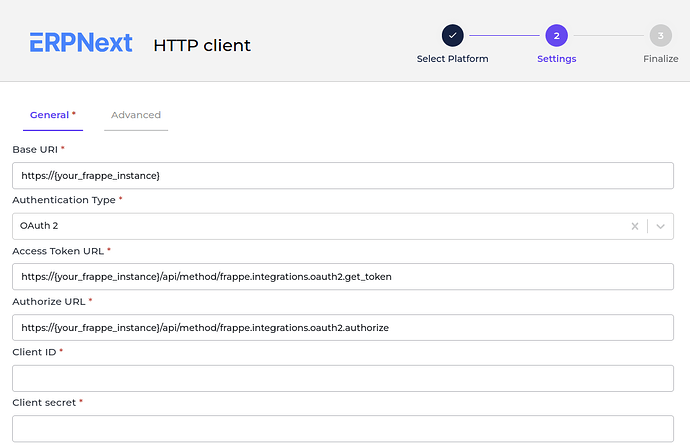
1.1 Steps- In the Alumio Dashboard, go to Clients -> HTTP Clients. Create a new HTTP Client and select “ERPNext HTTP Client” as the HTTP Client.
- Choose OAuth 2 for Authentication Type.
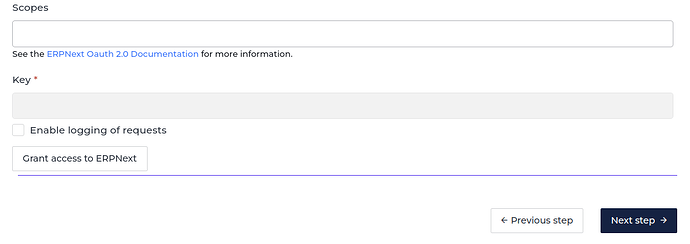
- Fill in the the Base URI Access Token URL, Authorize URL Client ID, Client Secret and Scope. (For more information, see ERPNext Oauth2 Authentication Reference)
- Click on “Grant access to ERPNext” and you will be redirected to approve the grant.
- You can optionally enable logging of request to get the log of the authentication.
- Save the HTTP Client for use.
- Alternatively, you can use Token Based Authentication. In that case, please select Token Based as Authentication Type, fill the Base URI and Token, then save the HTTP Client. (For more information, see ERPNext Token Based Authentication Reference)
2. Subscribing to Entities from ERPNext
2.1 Steps- Go to Connections -> Incoming and create a new incoming configuration and select “ERPNext Subscriber” as the subscriber.
- Select the entity you want to subscribe to from ERPNext.
- Add any request parameters needed to subscribe to the entity.
- Select the ERPNext HTTP Client to use.
- You can optionally add a transformer to transform the data into something you will be used to request from ERPNext.
- You can also optionally enable pagination to allow Alumio fetches paginated entities.
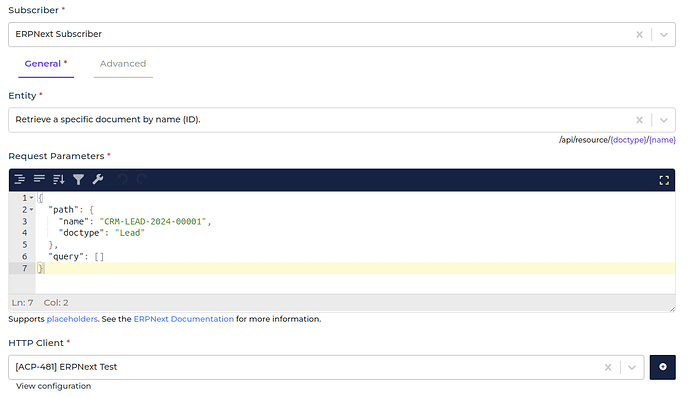
- Path is the path parameter of the url. For example the {id}.
- Query is defined set of parameters attached to the end of a url.
Example:www.url.com?type=true&start=0
3. Publishing Entity to ERPNext
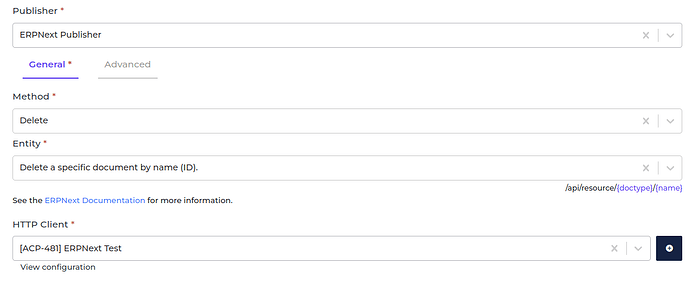
3.1 Steps- Go to Connections -> Outgoing, create a new outgoing configuration and select “ERPNext Publisher” as the publisher.
- Select the Method that you want the publisher to perform with the data.
- Select the ERPNext entity you want the data to be published to.
- You can optionally add any query data to the request on the key query.
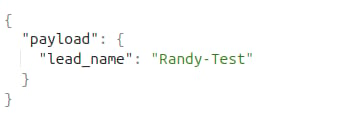
- You can optionally add any payload data to the request on the key payload.
- Select the HTTP Client to use.
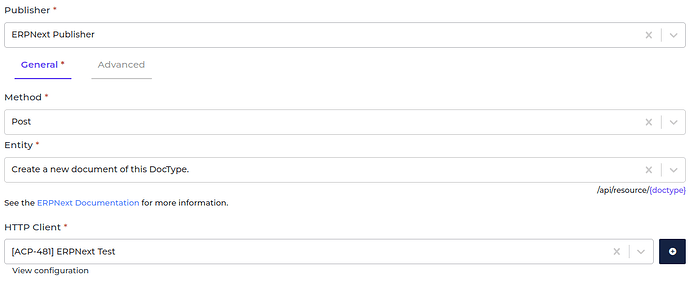
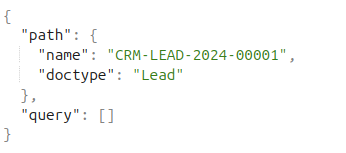
- Path is the path parameter of the url. For example the {id}.
- Query is defined set of parameters attached to the end of a url.
Example:www.url.com?type=true&start=0 - Payload is the data contained within a request.