> ## Documentation Index
> Fetch the complete documentation index at: https://docs.alumio.com/llms.txt
> Use this file to discover all available pages before exploring further.
# Build transformers with the Alumio Assistant
> Use the AI chat next to the transformer form to build and change transformers by describing what they should do.
The Alumio Assistant is a **beta feature**. It is not yet available in every environment, its behaviour may change between releases, and it can make mistakes. Always review what it proposes and test the transformer with the Transformer tester before you use it in a live integration.
The Alumio Assistant is an AI chat that opens next to the transformer form. You describe in plain language what a transformer should do, and the assistant builds it for you: it chooses the transformers to use, fills in their fields, names and describes every step and checks that the result is valid. You review the proposal and apply it to the form with one click.
## Open the assistant
1. Go to **Transformers** and create a new transformer or open an existing one.
2. Click the sparkles icon to open the chat. It opens as a panel beside the form. You can drag its edge to make it wider or narrower.
3. Type what you want to build, or pick one of the suggestions shown in an empty chat.
The assistant only works inside a transformer form. On other pages the chat stays readable, but you can't send messages until you open a transformer again.
If you don't see the sparkles icon:
* You may have hidden it. Open **User preferences** from the profile icon in the top-right corner and set **Alumio assistant** to **Show Alumio assistant**.
* Your role may not allow it. The assistant is available to users who can edit configurations, such as Editors and Administrators.
* The assistant may not be enabled for your environment yet.
## What the assistant can do
### Read your current transformer
Every time you send a message, the assistant reads the transformer as it is in the form at that moment, including changes you haven't saved yet.
When the form already holds a configuration, the assistant treats your message as a change to it, even when it reads like a new instruction. It keeps every step you don't mention exactly as it is and adds or changes only what you asked for. If you really want to throw the existing steps away, say so, for example "start over".
This also means you can ask questions about an existing transformer, such as "What does this transformer do?" or "Why are products without a SKU dropped?".
### Read your input data
When the Transformer tester is open and its **Input** tab holds data, the assistant reads that sample. It uses it to get field names, nesting and patterns right, instead of guessing what your data looks like.
For the best results, put a realistic record in the tester before you start the chat. Without a sample, the assistant works from your description and may ask what the data looks like.
You can also attach a file with the paperclip icon in the chat. Use this for example data that isn't the transformer's input, such as an example API response or the format you want to map to. Tell the assistant what the file represents. Attachments:
* must be text files, such as JSON, NDJSON, CSV, XML or YAML;
* can be up to 100 KB;
An attachment belongs to the message you send it with. Attach it again if you need it in a later message.
### Build transformers from your questions
Describe what the transformer should do, in your own words. For example:
| You want to | You could type |
| - | - |
| Reshape data | "Rename `sku` to `product_code` and move `price` into `pricing.amount`." |
| Filter data | "Skip products that have no price." |
| Map values | "Map the order status `processing` to `open` and `complete` to `closed`." |
| Call an API | "Send each order as a POST request to the orders endpoint and read the JSON response." |
| Store data | "Save each product in a storage, using the SKU as the key." |
For a clear task on a single data set, the assistant builds the transformer straight away.
 For a mapping between two systems, some choices are yours to make. Which fields should be included, how should existing records be matched, what should happen to data that has no counterpart in the target system? The assistant then proposes a mapping and lists the decisions it can't make for you, up to five at a time. Confirm the proposal or correct it in a single reply, answer the questions, and it builds the transformer.
Before it proposes a transformer, the assistant checks it against the same validation Alumio uses when you import a configuration. It doesn't run the transformer, so a valid transformer can still do something other than you meant. Test it with your own data.
### Name and describe each step
Every step the assistant adds gets a short name and a description of what that step does, so the transformer is easy to follow later. You see the name on the step in the form and the description when the step is collapsed, just like a name and description you set yourself.
Steps it doesn't change keep their existing names and descriptions. You can also ask it to write them for a transformer you built yourself, for example "Give every step a clear name and description".
### Ask you for connections and storages
Some transformers need an existing configuration, such as an HTTP connection to call an API or a storage to save data in. The assistant never guesses which one to use. It asks you, and a picker appears in the chat listing the configurations of that type in your environment.
For a mapping between two systems, some choices are yours to make. Which fields should be included, how should existing records be matched, what should happen to data that has no counterpart in the target system? The assistant then proposes a mapping and lists the decisions it can't make for you, up to five at a time. Confirm the proposal or correct it in a single reply, answer the questions, and it builds the transformer.
Before it proposes a transformer, the assistant checks it against the same validation Alumio uses when you import a configuration. It doesn't run the transformer, so a valid transformer can still do something other than you meant. Test it with your own data.
### Name and describe each step
Every step the assistant adds gets a short name and a description of what that step does, so the transformer is easy to follow later. You see the name on the step in the form and the description when the step is collapsed, just like a name and description you set yourself.
Steps it doesn't change keep their existing names and descriptions. You can also ask it to write them for a transformer you built yourself, for example "Give every step a clear name and description".
### Ask you for connections and storages
Some transformers need an existing configuration, such as an HTTP connection to call an API or a storage to save data in. The assistant never guesses which one to use. It asks you, and a picker appears in the chat listing the configurations of that type in your environment.
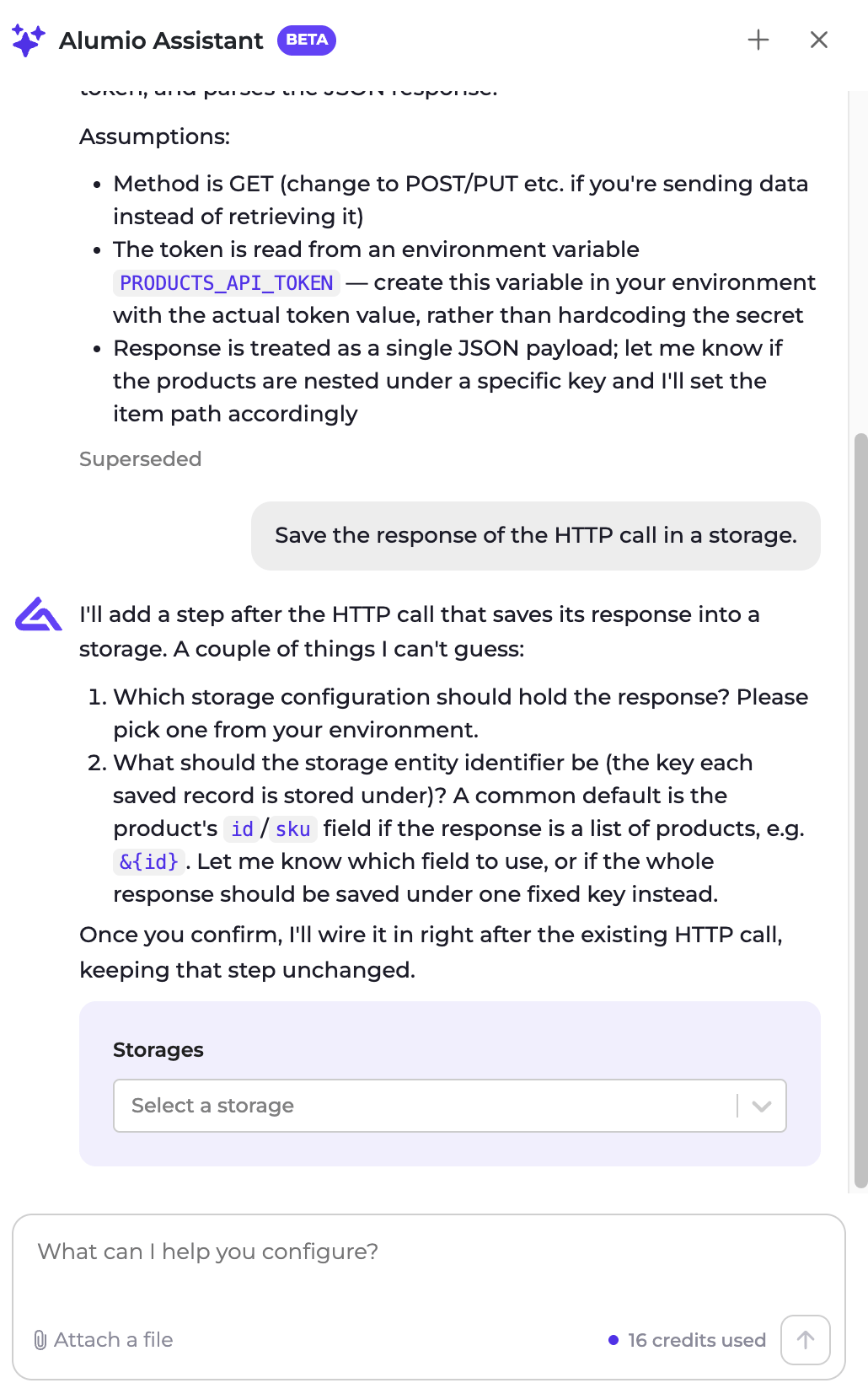 * **Pick one** from the list. Your choice is sent with your next message. You can add text to that message or send the selection on its own.
* **Create a new one** from the same picker, if your role allows it. A form opens where you set it up, and once you save it, the new configuration is selected.
* **Tell the assistant** when there are none and you can't create one. It then suggests another approach.
You can also name a configuration yourself, for example "Use the Shopify HTTP connection".
When the assistant looks up connections and storages, it only sees their names, not their settings. For API keys, passwords and other secrets it uses an [environment variable](/documentation/placeholders-and-patterns/environment-variables), such as `${SHOP_API_KEY}`, and tells you which variable to create.
## Review and apply a proposal
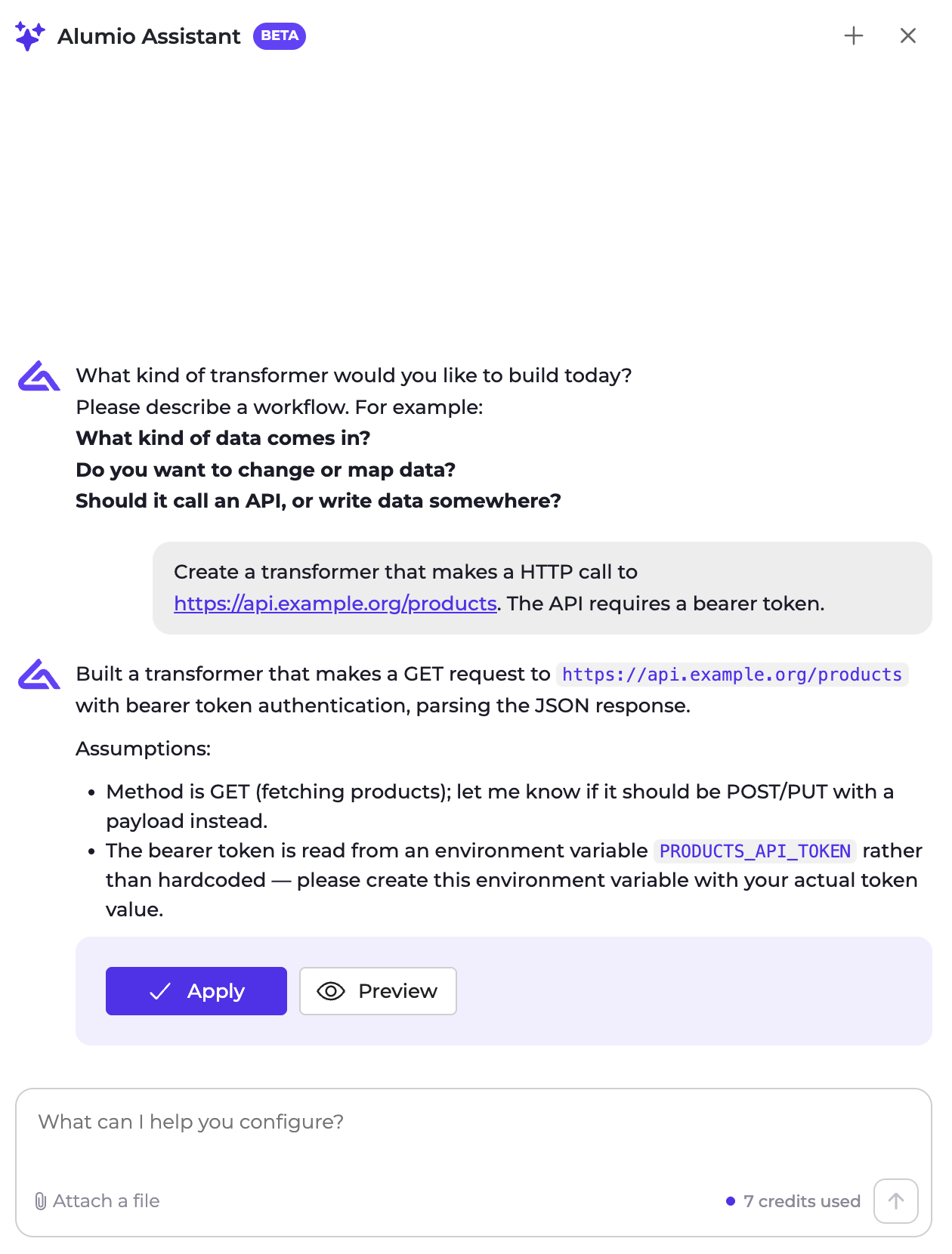
When the transformer is ready, the assistant summarises what it does and which assumptions it made. Two buttons appear below the message:
* **Preview** shows a read-only view of the form with the proposal filled in. You can apply it from there too.
* **Apply** puts the proposal into the form.
Applying only changes the transformer's configuration. Its name, identifier and description stay as they are, and nothing is saved yet. Review the form, test the transformer and save it as usual.
After applying, you can click **Undo** to put the form back the way it was before. Any changes you made to the form since applying are undone too.
A proposal can be applied once. When you send a new message, older proposals are marked **Superseded**. If you opened a different transformer since the conversation started, the assistant asks whether to apply the proposal to the transformer that is open now.
## Keep refining
You don't need to get everything right in the first message. Keep chatting to adjust the result, for example "Also skip products without a price" or "Use the storage for the value mapping instead". Each follow-up works on what is in the form.
If you haven't applied the previous proposal, the assistant builds on it anyway and says that the earlier changes are included.
To start over, click **+** (New chat) in the chat header. This clears the conversation, not the form. Closing the chat after a proposal was applied also starts a new conversation the next time you open it.
## Tips for good results
* Put a realistic record in the Transformer tester before you start.
* Be specific about where the data comes from, where it goes and which fields matter.
* Name the connections and storages you want to use.
* Keep one conversation per transformer and start a new chat for a new topic.
* Read the summary. The assistant states the assumptions it made, and those are the places to check first.
* Test the transformer before you use it in a route.
## Credits and limits
Each reply from the assistant uses AI credits. The chat shows how many credits the current conversation has used. Your environment has a monthly allowance, which you can follow in the **Credits** widget on the Dashboard. It resets at the start of each month. When it is used up, the assistant stops answering until the next month.
Other limits:
* A message can be up to 5,000 characters.
* An attachment can be up to 100 KB.
* A conversation expires after a period without activity. The chat then says it has expired, and **Start fresh** opens a new one.
## What the assistant doesn't do
During the beta, keep in mind that the assistant:
* only builds transformers, not routes, connections, schedulers or other configurations;
* doesn't save, run or test anything; you stay in control of every change;
* doesn't create connections or storages itself; it asks you to pick or create them;
* works only from the transformer in the form, the tester input, attachments, your messages and the names of existing configurations. These are sent to an AI model to produce a reply, so don't paste passwords or API keys into the chat.
* **Pick one** from the list. Your choice is sent with your next message. You can add text to that message or send the selection on its own.
* **Create a new one** from the same picker, if your role allows it. A form opens where you set it up, and once you save it, the new configuration is selected.
* **Tell the assistant** when there are none and you can't create one. It then suggests another approach.
You can also name a configuration yourself, for example "Use the Shopify HTTP connection".
When the assistant looks up connections and storages, it only sees their names, not their settings. For API keys, passwords and other secrets it uses an [environment variable](/documentation/placeholders-and-patterns/environment-variables), such as `${SHOP_API_KEY}`, and tells you which variable to create.
## Review and apply a proposal
When the transformer is ready, the assistant summarises what it does and which assumptions it made. Two buttons appear below the message:
* **Preview** shows a read-only view of the form with the proposal filled in. You can apply it from there too.
* **Apply** puts the proposal into the form.
Applying only changes the transformer's configuration. Its name, identifier and description stay as they are, and nothing is saved yet. Review the form, test the transformer and save it as usual.
After applying, you can click **Undo** to put the form back the way it was before. Any changes you made to the form since applying are undone too.
A proposal can be applied once. When you send a new message, older proposals are marked **Superseded**. If you opened a different transformer since the conversation started, the assistant asks whether to apply the proposal to the transformer that is open now.
## Keep refining
You don't need to get everything right in the first message. Keep chatting to adjust the result, for example "Also skip products without a price" or "Use the storage for the value mapping instead". Each follow-up works on what is in the form.
If you haven't applied the previous proposal, the assistant builds on it anyway and says that the earlier changes are included.
To start over, click **+** (New chat) in the chat header. This clears the conversation, not the form. Closing the chat after a proposal was applied also starts a new conversation the next time you open it.
## Tips for good results
* Put a realistic record in the Transformer tester before you start.
* Be specific about where the data comes from, where it goes and which fields matter.
* Name the connections and storages you want to use.
* Keep one conversation per transformer and start a new chat for a new topic.
* Read the summary. The assistant states the assumptions it made, and those are the places to check first.
* Test the transformer before you use it in a route.
## Credits and limits
Each reply from the assistant uses AI credits. The chat shows how many credits the current conversation has used. Your environment has a monthly allowance, which you can follow in the **Credits** widget on the Dashboard. It resets at the start of each month. When it is used up, the assistant stops answering until the next month.
Other limits:
* A message can be up to 5,000 characters.
* An attachment can be up to 100 KB.
* A conversation expires after a period without activity. The chat then says it has expired, and **Start fresh** opens a new one.
## What the assistant doesn't do
During the beta, keep in mind that the assistant:
* only builds transformers, not routes, connections, schedulers or other configurations;
* doesn't save, run or test anything; you stay in control of every change;
* doesn't create connections or storages itself; it asks you to pick or create them;
* works only from the transformer in the form, the tester input, attachments, your messages and the names of existing configurations. These are sent to an AI model to produce a reply, so don't paste passwords or API keys into the chat.